Web Design in Bangladesh: A Complete Step-by-Step Guide for Beginners and Businesses (2027)
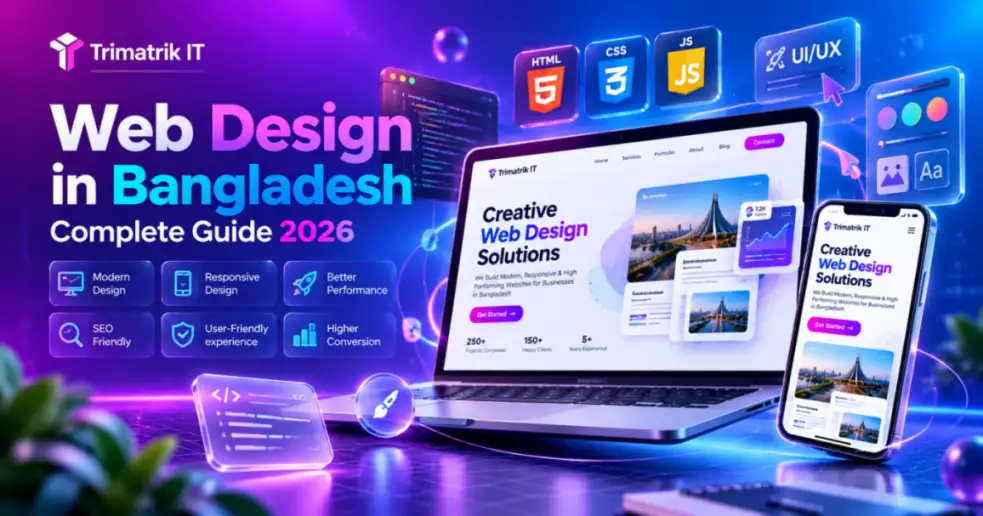
In today's digital world, a professional website is more than just an online presence. It is a powerful platform for building brand credibility, attracting customers, showcasing products or services, and supporting business growth.
Whether you are a business owner, entrepreneur, student, freelancer, or aspiring web designer, understanding web design can help you make better decisions about your digital future.
As businesses increasingly compete online, the demand for professional, responsive, and user-friendly websites continues to grow.
In this complete guide, Trimatrik IT explains everything you need to know about Web Design in Bangladesh, from basic concepts and essential technologies to UI/UX design, responsive development, SEO optimization, website costs, and launching a successful website.
1. What Is Web Design?
Web design is the process of planning, creating, and organizing the visual appearance, layout, navigation, and user experience of a website.
It includes several important elements:
Website layout and structure
Colors and visual identity
Typography and readability
Images, graphics, and icons
Navigation menus
User interface (UI)
User experience (UX)
Mobile responsiveness
Accessibility
Interactive elements
The main goal of web design is to create websites that are visually attractive, easy to navigate, accessible, and effective at helping users complete their goals.
For example, an e-commerce website should help visitors discover products, compare options, and complete purchases easily.
Similarly, a business website should clearly explain services, build trust, and make it convenient for customers to contact the company.
2. Why Is Web Design Important for Businesses?
A professionally designed website can play an important role in business success.
2.1 Builds Brand Credibility
A modern and well-organized website helps businesses communicate professionalism and reliability.
Visitors often form an impression of a business through its website design, content quality, and overall usability.
2.2 Improves User Experience
A user-friendly website allows visitors to find information quickly without unnecessary confusion.
Clear menus, readable content, and logical page structures improve navigation.
2.3 Supports Search Engine Optimization
Good web design provides a foundation for technical SEO.
Mobile-friendly layouts, accessible navigation, optimized images, and fast-loading pages can help search engines discover and understand website content.
2.4 Encourages Customer Conversions
A website with clear calls to action can encourage visitors to:
Request quotations
Book consultations
Contact a business
Subscribe to newsletters
Purchase products
Register for services
2.5 Supports Mobile Users
Customers frequently browse websites using smartphones.
Responsive web design ensures that content remains usable across different screen sizes.
2.6 Strengthens Digital Marketing
A professional website can serve as the central destination for SEO, social media marketing, email campaigns, and online advertising.
3. Web Design vs. Web Development: What's the Difference?
Although web design and web development are closely related, they serve different purposes.
Web Design
Web design focuses on the visual appearance and usability of a website.
It includes:
Layout planning
UI/UX design
Color selection
Typography
Wireframing
Prototyping
Visual consistency
Web Development
Web development focuses on building the functional website using programming technologies.
It includes:
Frontend development
Backend development
Database integration
API development
Content management systems
Authentication
Payment gateway integration
Example: A web designer creates the appearance of a shopping cart, while a web developer implements its functionality.
Many modern website projects require both disciplines.
4. Different Types of Websites
Before starting a web design project, you should identify the type of website you need.
4.1 Business Website
A business website introduces a company, its services, contact information, and brand identity.
Suitable for agencies, consulting firms, manufacturers, and service providers.
4.2 E-commerce Website
An e-commerce website allows businesses to sell products online.
Common features include product catalogs, shopping carts, checkout systems, and payment integrations.
4.3 Portfolio Website
A portfolio website showcases professional skills, completed projects, achievements, and creative work.
Ideal for freelancers, developers, designers, photographers, and agencies.
4.4 Educational Website
Educational websites provide information and digital services for schools, colleges, universities, and training institutions.
Advanced solutions may include admission management, attendance, examination systems, student portals, and learning management systems.
4.5 Blog Website
A blog website publishes articles, guides, tutorials, industry insights, and educational content.
4.6 Corporate Website
Corporate websites communicate organizational information, services, company profiles, careers, and business achievements.
4.7 Custom Web Application
A custom web application provides specialized functionality for a particular business process.
Examples include inventory management systems, HR and payroll software, booking platforms, and customer relationship management systems.
5. Essential Elements of Professional Web Design
A successful website combines attractive design with practical usability.
Clean Layout
Use a well-structured layout with enough whitespace to keep information readable.
Consistent Branding
Maintain consistent colors, fonts, icons, and visual elements throughout the website.
Clear Navigation
Visitors should easily understand where to find important information.
Readable Typography
Choose appropriate font sizes, line spacing, and contrast.
High-Quality Images
Use relevant, optimized images that support the website's content.
Effective Calls to Action
Place clear buttons such as "Contact Us," "Get a Quote," or "Book a Demo" where users need them.
Mobile Responsiveness
Ensure that pages adapt to smartphones, tablets, laptops, and desktop computers.
Accessibility
Support keyboard navigation, meaningful labels, descriptive image alternatives, and sufficient text contrast.
Performance
Optimize loading speed, image sizes, scripts, and visual effects.
6. Step-by-Step Web Design Process: From Planning to Launch
Creating a professional website requires a structured workflow.
Step 1: Define Your Website Goals
Before designing anything, identify the purpose of your website.
Ask yourself:
Who is the target audience?
What problems will the website solve?
What actions should visitors take?
Which products or services will be featured?
What business outcomes are important?
Example: A software company's website might focus on presenting solutions, displaying product demonstrations, and generating consultation requests.
Step 2: Research Your Target Audience
Understand the needs, expectations, and browsing habits of potential visitors.
Consider their preferred devices, common questions, and information requirements.
This research helps you create a website that serves real users rather than focusing only on visual trends.
Step 3: Analyze Competitor Websites
Review relevant competitors to identify useful features, navigation patterns, and opportunities for differentiation.
Evaluate:
Website structure
Design quality
Mobile usability
Content organization
Calls to action
Loading performance
Avoid copying competitors directly. Use research to develop your own distinctive design.
Step 4: Plan the Website Structure
Create a sitemap showing the main pages and their relationships.
A typical business website may include:
Home
About Us
Services
Portfolio
Blog
FAQ
Contact Us
Larger websites may require additional pages, categories, or customer portals.
Step 5: Create Wireframes
A wireframe is a simplified visual layout showing where content and interface elements will appear.
Wireframes help determine the placement of headings, images, navigation menus, forms, and buttons before detailed visual design begins.
Step 6: Design the UI/UX
Create the visual interface using a design tool such as Figma.
Focus on:
Brand colors
Typography
Buttons
Navigation
Cards and sections
Mobile layouts
Consistent spacing
Interactive states
A good design should be attractive without sacrificing usability.
Step 7: Choose the Right Technology
The technology stack depends on the website's requirements.
Common technologies include:
Frontend: HTML5, CSS3, JavaScript, React, Next.js, and Tailwind CSS.
Backend: Node.js, PHP, Laravel, or other suitable server-side technologies.
Databases: MySQL, PostgreSQL, or MongoDB.
CMS: WordPress and other content management platforms.
Design Tools: Figma, Adobe Photoshop, and Illustrator.
Choose technologies based on project complexity, maintainability, budget, and long-term requirements.
Step 8: Develop the Website
Convert the approved design into a functional website.
Development tasks may include:
Creating responsive layouts
Implementing navigation
Building interactive components
Integrating APIs
Connecting databases
Configuring forms
Developing administrative features
Use clean, maintainable code and appropriate security practices.
Step 9: Optimize for Mobile Devices
Test the website on different screen sizes.
Check whether text is readable, buttons are easy to tap, menus function correctly, and content fits within the viewport.
Responsive design should be considered throughout development rather than added only at the end.
Step 10: Implement SEO Best Practices
Prepare each important page for search engines.
Include:
Descriptive page titles
Relevant meta descriptions
Clear heading hierarchy
SEO-friendly URLs
Internal links
Descriptive image alt text
Structured data where appropriate
XML sitemap
Mobile-friendly design
Create useful, original content that answers the questions your audience is searching for.
Step 11: Improve Website Performance
A fast website provides a better user experience.
Performance optimization techniques include:
Compressing images
Using modern image formats
Minimizing unnecessary JavaScript
Enabling browser caching
Lazy-loading appropriate content
Optimizing fonts
Using reliable hosting
Reducing unnecessary third-party scripts
Monitor Core Web Vitals, including Largest Contentful Paint (LCP), Interaction to Next Paint (INP), and Cumulative Layout Shift (CLS).
Step 12: Test the Website
Before launching, test all important features.
Review:
Navigation links
Contact forms
Mobile layouts
Browser compatibility
Accessibility
Page loading
Security configuration
Error handling
Checkout or payment functionality, if applicable
Fix any major issues before publishing.
Step 13: Choose Hosting and Domain
Register a domain that is memorable and relevant to your brand.
Select hosting based on expected traffic, website technology, security, and performance needs.
Configure HTTPS using a valid TLS certificate.
Step 14: Launch Your Website
Deploy the website to the production environment.
Check that:
All pages load correctly
Forms send submissions successfully
HTTPS works
Analytics is configured appropriately
Search engines can access intended public pages
Important URLs are included in the sitemap
Step 15: Maintain and Improve
Website development does not end after launch.
Regular maintenance includes software updates, backups, security monitoring, content updates, performance checks, and usability improvements.
Use analytics and customer feedback to guide future changes.
7. Popular Web Design Tools and Technologies in 2026
Different tools serve different purposes in the web design workflow.
Tool or Technology | Main Purpose |
|---|---|
Figma | UI/UX design and prototyping |
HTML5 | Website structure |
CSS3 | Styling and responsive layouts |
JavaScript | Interactive functionality |
React | Component-based user interfaces |
Next.js | React-based web applications |
Tailwind CSS | Utility-first styling |
WordPress | Content management |
WooCommerce | E-commerce functionality |
Git & GitHub | Version control and collaboration |
Three.js | Interactive 3D graphics |
GSAP | Advanced web animations |
The best technology is not necessarily the newest one. It is the technology that fits the project's actual needs.
8. What Is Responsive Web Design?
Responsive web design is an approach that allows website layouts to adapt to different devices and screen sizes.
A responsive website adjusts elements such as navigation menus, columns, images, typography, and spacing.
Benefits of Responsive Design
Better mobile usability
More consistent user experience
Easier website maintenance
Improved accessibility across devices
Support for mobile-friendly SEO practices
Modern websites should be designed with mobile users in mind from the beginning.
9. What Is UI/UX Design?
UI and UX are two essential parts of modern web design.
User Interface (UI)
UI focuses on the visible and interactive components of a website, such as buttons, menus, forms, cards, and visual layouts.
User Experience (UX)
UX focuses on how easily and effectively users can interact with the website.
For example, a visually attractive checkout page may have excellent UI, but if customers struggle to complete payments, the UX needs improvement.
The best websites combine attractive UI with practical UX.
10. SEO-Friendly Web Design: Essential Best Practices
Search Engine Optimization should be considered during the design and development process.
Use Clear Heading Structures
Organize content with one descriptive primary heading and logical supporting headings.
Optimize Page Titles
Create unique, relevant titles that accurately describe each page.
Write Helpful Content
Publish content that answers real user questions and demonstrates expertise.
Improve Mobile Usability
Ensure users can navigate and read the website comfortably on smaller screens.
Optimize Images
Use descriptive filenames, appropriate image dimensions, compression, and meaningful alt text.
Build Internal Links
Connect related pages to help visitors and search engines discover useful content.
Improve Technical Performance
Monitor loading performance, indexing, structured data, and technical errors.
Use HTTPS
Protect data in transit by serving the website over HTTPS.
Important: SEO-friendly design improves a website's technical foundation, but it does not guarantee a particular Google ranking.
11. How Much Does Web Design Cost in Bangladesh?
Website design costs in Bangladesh vary significantly depending on the scope and requirements.
Major pricing factors include:
Number of pages
Custom UI/UX requirements
Responsive design complexity
Content management features
E-commerce functionality
Payment gateway integration
Backend development
Custom dashboards
Third-party integrations
Hosting and maintenance requirements
A simple informational website generally requires less development work than a custom e-commerce platform or enterprise web application.
For accurate pricing, prepare a clear project brief and request a quotation based on your specific requirements.
12. Common Web Design Mistakes to Avoid
Even visually attractive websites can perform poorly when important usability principles are ignored.
Common mistakes include:
Overcomplicated navigation
Slow-loading images and animations
Poor mobile responsiveness
Inconsistent branding
Unreadable text
Weak calls to action
Missing accessibility features
Unclear content structure
Outdated information
Insufficient testing before launch
Avoiding these mistakes can improve usability, maintainability, and customer satisfaction.
13. Modern Web Design Trends in 2026
Web design continues to evolve as technologies and user expectations change.
Minimalist Interfaces
Clean layouts, generous whitespace, and clear visual hierarchy remain popular.
3D and Interactive Elements
Subtle 3D graphics and animations can make digital experiences more engaging when used thoughtfully.
Microinteractions
Small animations provide feedback when users click buttons, submit forms, or navigate interfaces.
Dark Mode
Dark interfaces can offer an alternative visual experience when implemented with appropriate contrast.
AI-Assisted Workflows
AI tools can support brainstorming, content drafting, prototyping, and development workflows, while human review remains important for accuracy and quality.
Accessibility-Focused Design
More teams are integrating accessibility into their design systems and development processes.
Performance-First Development
Businesses increasingly benefit from lightweight, responsive websites that work well across devices and network conditions.
The best approach is to adopt trends that improve the user experience rather than adding effects simply because they look impressive.
14. How to Choose a Professional Web Design Company in Bangladesh
Selecting the right web design company is an important business decision.
Before hiring an agency, consider the following:
Portfolio Quality: Review completed projects and relevant industry experience.
Technical Expertise: Confirm that the team understands your required technologies and integrations.
Responsive Design: Ask how the website will perform across different devices.
SEO Knowledge: Evaluate whether the agency follows technical SEO best practices.
Communication: Choose a team that explains project requirements, timelines, and deliverables clearly.
Security: Discuss updates, backups, access control, and secure deployment.
Support: Clarify what happens after the website launches.
Pricing Transparency: Request a detailed quotation with clear deliverables.
A reliable development partner should understand both your business objectives and technical requirements.
15. Why Consider Trimatrik IT for Web Design & Development?
Trimatrik IT focuses on creative digital solutions and modern website experiences.
Our web design and development approach emphasizes:
Professional UI/UX design
Responsive website layouts
Business-focused website structures
Custom web development
E-commerce website solutions
SEO-friendly architecture
Performance-conscious development
Interactive and modern visual experiences
Whether you need a corporate website, an online store, a professional portfolio, or a custom web application, the right design and development strategy can help establish a stronger digital presence.
Our goal is to combine creative design, practical functionality, and modern technologies to deliver solutions aligned with business requirements.
16. Frequently Asked Questions (FAQs)
Q1. What is web design?
Web design is the process of creating a website's layout, visual appearance, navigation, and user experience.
Q2. What is the difference between web design and web development?
Web design focuses on visual appearance and usability, while web development focuses on implementing website functionality using programming technologies.
Q3. Is web design a good career in 2026?
Web design remains a useful digital skill. Career opportunities depend on practical ability, portfolio quality, communication, and knowledge of modern tools and user experience principles.
Q4. Which programming languages are important for web design?
HTML, CSS, and JavaScript are foundational technologies for building modern websites. Designers may also benefit from learning UI/UX tools such as Figma.
Q5. How long does it take to design a website?
The timeline depends on project complexity, content availability, feedback cycles, and required functionality. Simple websites may take less time than custom business applications.
Q6. Can a website be designed without coding?
Yes. Website builders and content management systems can help create websites with limited coding, although custom features may require development knowledge.
Q7. What makes a website SEO-friendly?
An SEO-friendly website typically includes helpful content, clear navigation, descriptive titles, mobile usability, optimized images, internal links, and sound technical architecture.
Q8. Why is responsive web design important?
Responsive design helps websites remain usable across mobile phones, tablets, laptops, and desktop computers.
Q9. How much does a professional website cost in Bangladesh?
Pricing depends on design requirements, number of pages, features, integrations, and ongoing support. A project-specific quotation provides the most accurate estimate.
Q10. Can Trimatrik IT create a custom website?
Trimatrik IT presents web design and development solutions for business websites, e-commerce platforms, portfolios, and custom web applications. Contact the team to discuss specific requirements and project availability.
17. Final Thoughts
Professional web design combines creativity, technology, usability, accessibility, and performance.
A successful website should not only look attractive but also provide clear information, support business objectives, and deliver a smooth experience across different devices.
Whether you are learning web design or planning a new business website, following a structured process—from research and UI/UX design to development, SEO, testing, and maintenance—can help you achieve better results.
If you are looking for professional web design in Bangladesh, start by identifying your goals, understanding your audience, and choosing a development approach that supports your long-term needs.
Ready to Build Your Professional Website?
Transform Your Ideas into Powerful Digital Experiences with Trimatrik IT.
Explore modern web design, responsive development, e-commerce solutions, and custom digital experiences.
Contact Trimatrik IT to discuss your next website project.
- #تجريبي
التعليقات
سجّل الدخول كعميل لترك تعليق.