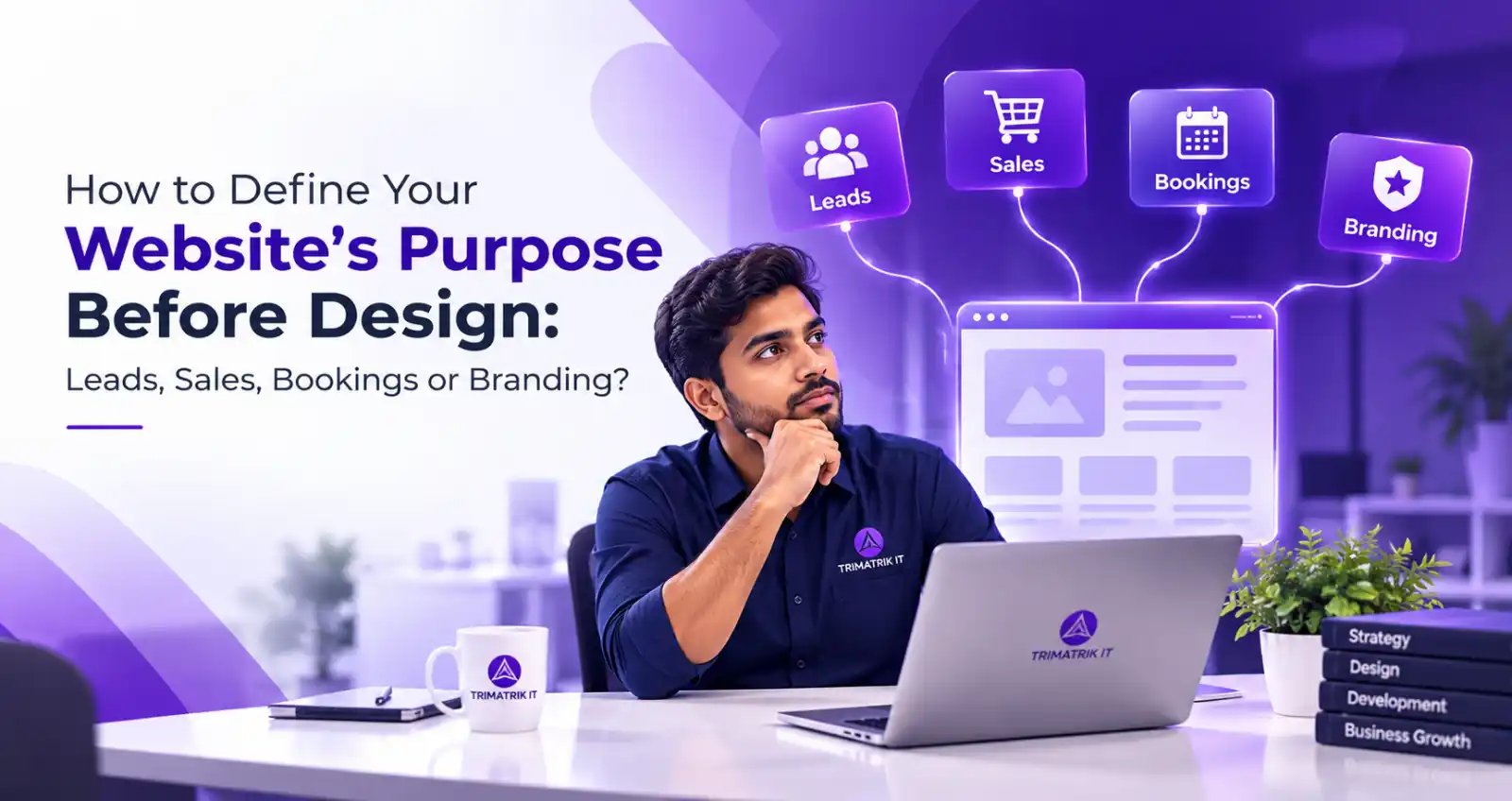
How to Define Your Website’s Purpose Before Design: Leads, Sales, Bookings or Branding?
جدول المحتويات
Why Website Purpose Must Come Before Website Design
A beautiful website can still fail commercially.
A corporate website may look premium but generate almost no inquiries because the contact journey is unclear. An e-commerce site may have attractive product pages but lose customers because checkout is complicated. A clinic may spend heavily on a modern website when patients really need a fast appointment-booking interface. A B2B company may invest in hundreds of pages when its actual objective is to convince procurement managers to request a quotation.
When purpose is defined first, design becomes strategic rather than decorative.
The purpose determines:
Who the primary audience is, what action they should take, what information they need before taking that action, which pages are essential, which integrations are required, what performance should be measured, and how the website should support the wider business.
A good website design process should therefore start with business questions before visual questions.
The Four Major Website Purposes
For most businesses, the primary purpose can be grouped into four categories:
Lead Generation
Online Sales
Bookings or Appointments
Branding and Corporate Presence
A business may need more than one, but one objective should normally have priority.
1. Lead Generation Website
A lead generation website is designed to convert visitors into potential customers.
This type of website works particularly well for businesses where customers usually need consultation, quotation, technical discussion, site assessment, demonstration, or negotiation before purchasing.
In Bangladesh, this model is suitable for industries such as:
Software and IT services
Construction and interior design
CCTV and security solutions
Corporate suppliers
Real estate
Education consultancy
Logistics
Industrial equipment
Digital marketing agencies
B2B professional services
The primary conversion may be:
Request a Quote, Book a Consultation, Request a Demo, Call Now, Send an Inquiry, or Talk to an Expert.
What a Lead Generation Website Needs
The design should communicate value quickly. A visitor should understand what the company offers, who it serves, why it can be trusted, and what to do next.
Important elements include service landing pages, clear contact forms, phone and messaging options, testimonials, case studies, certifications, portfolio examples, FAQs and prominent calls to action.
Search engine optimization is especially important because high-intent searches such as “HR software company in Bangladesh,” “website development company Bangladesh,” or “CCTV installation company in Dhaka” can bring users who are already actively evaluating suppliers.
For lead-generation websites, success should not be measured only by traffic. The more meaningful metrics are qualified inquiries, cost per lead, consultation requests, form completion rate and lead-to-customer conversion.
2. E-Commerce and Online Sales Website
For an e-commerce website, the purpose is more direct:
Help visitors discover products, build confidence and complete a purchase.
This changes the design priorities completely.
Instead of placing most attention on corporate information, the website needs strong product discovery, search, filtering, categories, pricing, availability, product specifications, reviews, cart management, checkout and payment options.
Bangladesh's digital payment environment makes this increasingly relevant. Bangladesh Bank reported about 240.46 million registered MFS accounts by February 2025, alongside roughly 1.86 million agents. However, Bangladesh Bank research also noted that a large share of MFS transaction value remained related to cash-in and cash-out activity, illustrating that consumer payment behaviour is still mixed between digital and cash-oriented patterns. BB Bank
That has an important implication for website planning: a Bangladeshi e-commerce business should not design checkout based only on what looks modern internationally. It should consider its own customers' preferred payment and fulfilment behaviours.
Depending on the business, the website may need support for mobile financial services, bank payments, cards, cash on delivery, delivery charges by location, stock status and order confirmation workflows.
Core E-Commerce Objectives
A sales-focused website should optimize:
Product discovery
Add-to-cart rate
Checkout completion
Average order value
Repeat purchases
Customer confidence
Mobile shopping experience
Every unnecessary step between the product page and purchase can reduce conversion.
3. Booking and Appointment Website
Some websites do not need to sell a product immediately. Their most valuable action is securing a time slot.
This is common for:
Doctors and clinics
Diagnostic centers
Consultants
Training providers
Hotels and resorts
Travel companies
Salons and beauty services
Legal professionals
Equipment rental
Service centers
In these cases, the website should be designed around availability and convenience.
A potential customer should be able to choose a service, select a date or time, provide the necessary details and receive confirmation without unnecessary communication.
A booking-focused website may need calendar integration, automated notifications, online payments, booking rescheduling, branch selection, employee or consultant selection, service duration management and CRM integration.
Why This Matters
If the real business goal is booking appointments, making visitors complete a long general contact form is poor design.
The website architecture should minimize the distance between intent and confirmation.
The primary metric becomes completed bookings, not page views.
4. Branding and Corporate Presence Website
Not every website should aggressively push sales.
For manufacturers, exporters, established corporate organizations, investors, professional firms and companies operating through distributors or tender processes, the website may primarily exist to build credibility.
Potential customers often visit a company website after hearing about the brand elsewhere.
They may want to verify:
Who is this company?
How long has it operated?
What industries does it serve?
Who are its clients?
What projects has it completed?
Is the company legitimate?
Does it have technical capability?
For this type of website, design, copywriting, photography, company profile, leadership information, projects, certifications, testimonials, case studies and professional presentation become central.
The conversion may still be an inquiry, but trust comes before conversion.
A strong corporate website can also support recruitment, partnerships, distributors, tenders, investors and international buyers.
The Bangladesh Market: Why Purpose Matters More Than Ever
Bangladesh is increasingly digital, but customer behaviour is fragmented across search engines, social media, mobile communication and physical commerce.
DataReportal reported 60 million social media user identities in Bangladesh in early 2025, while Facebook's advertising tools also indicated potential reach of roughly 60 million users. DataReportal – Global Digital Insights
This means many customers may first discover a company through Facebook, YouTube, an advertisement, a marketplace, Google Search or a personal recommendation and only visit the website later.
The website therefore needs to perform the next job in the customer journey.
For example:
A Facebook advertisement may generate awareness, but the website must establish trust.
A Google search may reveal buying intent, so the landing page must convert that intent.
A sales executive may send a website link to a prospect, so the website must reinforce the salesperson's presentation.
A customer may find a product on social media, then visit the website to compare specifications and pricing.
The purpose of the website should therefore align with how customers actually move from awareness to decision.
Start With One Primary Business Goal
One of the most common website planning mistakes is trying to make everything equally important.
A homepage cannot simultaneously prioritize:
“Buy Now,”
“Request a Quote,”
“Book a Demo,”
“Read Our Story,”
“Join Our Team,”
and
“Become a Distributor.”
When every action looks equally important, users often take none.
Instead, define one primary conversion and a few secondary actions.
For example:
Primary: Request a quotation
Secondary: Call / WhatsApp / view portfolio
Or:
Primary: Buy product
Secondary: Ask product question
Or:
Primary: Book appointment
Secondary: Call clinic
This hierarchy should influence buttons, navigation, landing pages and website content.
Define Your Target Audience Before Designing
A website built for corporate procurement managers should not look or behave like one designed for teenage consumers.
Ask:
Who is the decision-maker?
What problem are they trying to solve?
How much information do they need before contacting us?
Are they comparing several suppliers?
Do they primarily browse on mobile?
Are they comfortable purchasing online?
Do they need approval from someone else?
What creates trust for them?
A software buyer might want feature lists, deployment information, case studies and a demo.
A parent evaluating school management software may care about attendance, fees, results and parent communication.
A consumer buying electronics may prioritize price, warranty, delivery time and product specifications.
The same website design cannot optimize equally for every audience.
Map the Customer Journey
Before UI/UX design begins, map the path from visitor to business result.
For lead generation:
Google → Service Page → Proof → Inquiry Form → Sales Team
For e-commerce:
Ad/Search → Product Page → Cart → Checkout → Payment → Delivery
For booking:
Search/Social → Service Page → Schedule → Confirmation
For branding:
Referral/Search → Homepage → About/Projects → Trust → Contact
This exercise helps determine which pages should receive the greatest design attention.
Decide What Content the Website Actually Needs
Purpose should determine content.
A lead-generation website needs strong landing pages, FAQs, testimonials and conversion-oriented copy.
An e-commerce website needs high-quality product photos, specifications, categories, comparisons and buying information.
A booking website needs service descriptions, availability and simple reservation workflows.
A branding website needs company history, capabilities, achievements, projects and professional visuals.
Creating content before defining purpose often results in pages that exist because competitors have them—not because customers need them.
Design Mobile-First for Bangladesh
Mobile experience should be a central planning requirement.
BTRC's April 2026 statistics recorded 116.47 million mobile internet subscriptions compared with 14.95 million ISP/PSTN internet subscriptions. While subscription counts are not the same as unique users, the difference illustrates how important mobile connectivity is in Bangladesh. BTRC
A mobile-first business website should therefore provide:
Fast loading pages, readable text, large touch targets, simplified navigation, compressed images, short forms, sticky calls to action and clear contact options.
A desktop-first website that becomes difficult to use on mobile risks losing a significant part of the market.
Define Required Integrations Early
Website integrations should not be added as an afterthought.
Depending on the objective, businesses may need:
CRM systems, ERP software, inventory, HR software, payment gateways, MFS payments, Google Analytics, Meta Pixel, WhatsApp, email marketing, booking calendars, live chat, delivery systems or accounting software.
For example, a lead-generation website without CRM integration may successfully generate inquiries but still lose them because the sales team does not follow up consistently.
The website is only one part of the business system.
Establish KPIs Before Launch
If you cannot define success before development, it becomes difficult to evaluate the website afterwards.
Different purposes require different KPIs.
Website Purpose | Primary KPI |
|---|---|
Lead Generation | Qualified leads |
E-Commerce | Completed sales |
Booking | Confirmed bookings |
Branding | Engagement and qualified inquiries |
SaaS | Demo requests / sign-ups |
Recruitment | Completed applications |
Additional metrics may include conversion rate, organic traffic, bounce rate, cost per acquisition, average order value and returning visitors.
Common Website Planning Mistakes in Bangladesh
Businesses frequently focus on visual design first and strategy second.
Typical mistakes include copying a competitor's homepage, placing too many services on one page, hiding contact information, using generic stock content, ignoring mobile speed, building without SEO planning, creating complicated inquiry forms and launching without analytics.
Another common problem is asking developers:
“How much does a website cost?”
before defining what the website needs to accomplish.
A five-page company profile and a custom e-commerce platform are both “websites,” but their business requirements are completely different.
Purpose must come before quotation.
Can One Website Have Multiple Purposes?
Yes.
A well-planned website can serve several objectives.
For example, TRIMATRIK IT LTD. may use its website to:
Generate software development inquiries, showcase SaaS products, allow consultation bookings, publish SEO content and establish corporate credibility.
However, each major section should have a clear objective.
The homepage might introduce the company and direct users toward services or products.
A software service page may generate quotations.
A SaaS product page may generate demos.
A blog may attract organic traffic.
A careers section may collect applications.
Multiple purposes work when they are organized—not when they compete for attention.
A Practical Website Purpose Framework
Before starting your next website project, document the following:
Business Goal: What should the website achieve?
Primary Audience: Who should take action?
Primary Conversion: What exact action matters most?
Traffic Sources: Google, social media, advertisements, referrals or direct visits?
Trust Factors: Testimonials, certifications, client logos, case studies, pricing or guarantees?
Required Features: Forms, checkout, booking, CRM, payment, search or integrations?
Content Strategy: What information does the customer need before converting?
KPIs: How will performance be measured?
Once these questions are answered, designers and developers can make much better decisions.
Conclusion
Defining your website's purpose before design is one of the most important decisions in the entire development process.
A website designed to generate leads should not behave like an online store. A booking platform should not force customers through a general inquiry process. A corporate website should not sacrifice trust and credibility simply to place more buttons on the screen.
For businesses in Bangladesh, the combination of growing internet usage, mobile connectivity, social media discovery and expanding digital payments means that websites increasingly influence real purchasing decisions. BTRC
The correct approach is simple:
Define the business goal first. Understand the customer journey second. Design the website third.
At TRIMATRIK IT LTD., website planning should begin with how the business actually works—not merely how the website should look.
TRIMATRIK IT LTD. — Software, IT and growth — one team.
Frequently Asked Questions
1. What is the purpose of a business website?
A business website should support a measurable objective such as generating leads, selling products, receiving bookings, building credibility or supporting customers.
2. Why should website purpose be defined before design?
Purpose determines the site structure, content, calls to action, technology, integrations and performance metrics.
3. What is a lead-generation website?
It is a website designed primarily to turn visitors into prospects through quotation requests, consultations, demos, calls or inquiry forms.
4. Which businesses in Bangladesh need lead-generation websites?
Software companies, real estate firms, construction businesses, B2B suppliers, agencies, consultancies and professional service providers commonly benefit from them.
5. What is the main purpose of an e-commerce website?
Its primary purpose is to help customers discover products and complete purchases efficiently.
6. Should an e-commerce website support mobile payments?
Businesses should evaluate the payment methods preferred by their target customers, including relevant digital payment, banking and cash-based options.
7. What businesses need booking websites?
Clinics, doctors, hotels, consultants, salons, training organizations, travel companies and service businesses often benefit from booking functionality.
8. What is a branding website?
A branding or corporate website focuses on company credibility, reputation, capabilities and professional presentation.
9. Can a website generate leads and build a brand simultaneously?
Yes. One can be the primary goal while credibility-building content supports the conversion process.
10. Should every website have an online payment system?
No. Payment functionality should only be added when it supports the actual customer journey.
11. How do I choose my website's primary CTA?
Choose the action that is most closely connected to revenue or the next important step in your sales process.
12. Is mobile-friendly design important in Bangladesh?
Yes. BTRC data show that mobile internet subscriptions substantially outnumber fixed internet subscriptions, making mobile usability particularly important. BTRC
13. Does SEO depend on website purpose?
Yes. SEO keywords, landing pages and content should target searches that support the site's commercial objective.
14. Should I copy a competitor's website structure?
Competitors can provide useful references, but your website should reflect your own customers, business model and conversion goals.
15. How many calls to action should a homepage have?
You can have several CTAs, but one should normally be visually and strategically primary.
16. What information should a lead-generation website collect?
Usually name, contact information and enough information about the requirement for the sales team to respond effectively.
17. Should a website connect with CRM software?
For businesses managing many inquiries, CRM integration can improve lead tracking, follow-up and reporting.
18. How can I measure whether my website is successful?
Measure results aligned with its purpose: leads, sales, bookings, sign-ups, applications or other defined conversions.
19. What is more important: website traffic or conversions?
Traffic is useful only when it attracts relevant visitors and contributes to meaningful business outcomes.
20. Should website content be prepared before development?
Core messaging, service information, conversion goals and content structure should ideally be planned early because they affect the design.
21. Does a Bangladeshi business need both English and Bangla content?
It depends on the target audience. Local consumer businesses may benefit significantly from Bangla, while B2B or international businesses may prioritize English or use both.
22. Can social media replace a website?
Social media is excellent for discovery and engagement, but a website provides greater control over branding, search visibility, conversion journeys, data and business information.
23. What should a startup prioritize on its first website?
A startup should clearly communicate the problem it solves, its target customer, its value proposition and one strong conversion action.
24. When should a website be redesigned?
A redesign may be necessary when the site no longer reflects the business strategy, performs poorly on mobile, loads slowly, generates few conversions or cannot support required integrations.
25. What should I discuss with a web development company before requesting a quotation?
Explain your business objectives, customers, required features, integrations, content needs, expected conversions and future expansion plans before discussing design and cost.
- #تجريبي