
App Development in Bangladesh: Complete Guide 2026
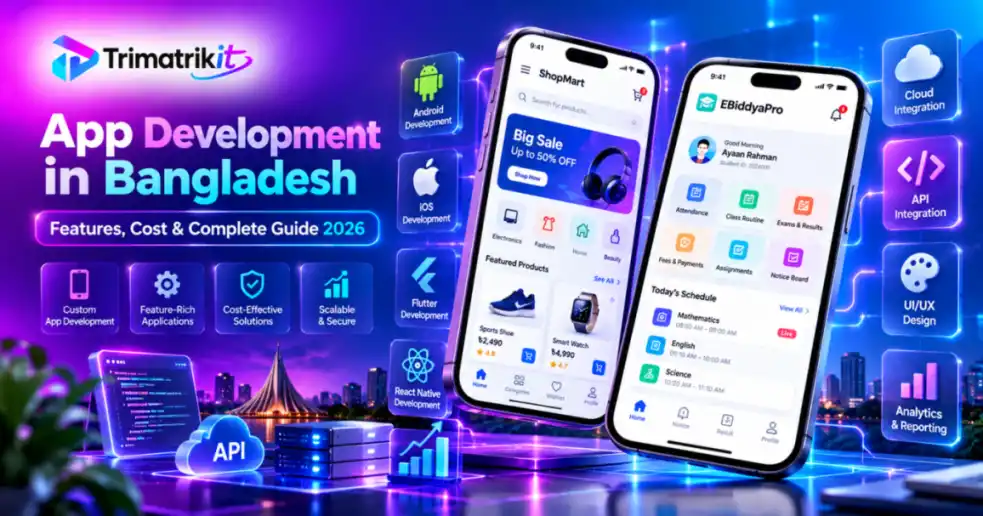
App Development in Bangladesh: Features, Cost, Technologies & Complete Guide 2026
Mobile applications have become an important part of modern digital business. From online shopping and education to healthcare, banking, logistics, and customer service, mobile apps help organizations connect with users and deliver services through smartphones.
As smartphone adoption and digital services continue to develop, businesses are increasingly exploring App Development in Bangladesh to improve customer experiences, simplify operations, and expand their digital capabilities.
However, building a successful mobile application requires more than an attractive design. Businesses must understand their users, select appropriate technologies, define essential features, establish a realistic budget, and plan for long-term maintenance.
In this complete guide, Trimatrik IT explains what app development is, how mobile applications work, the differences between Android and iOS development, important features, development costs, technologies, and how to select the right app development company in Bangladesh.
1. What Is App Development?
App Development is the process of planning, designing, building, testing, and maintaining software applications that run on mobile devices, tablets, computers, or other digital platforms.
Mobile app development focuses specifically on applications designed for smartphones and tablets.
These applications may help users purchase products, book appointments, access educational resources, communicate with businesses, manage financial activities, or perform specialized tasks.
For example, an e-commerce application allows customers to browse products and place orders through their smartphones.
A school management application may provide students and guardians with access to attendance records, academic notices, examination results, and fee information.
A business management application may help employees monitor inventory, manage customer records, or review operational reports.
The primary goal of app development is to create a reliable, secure, and user-friendly application that solves a specific problem.
2. Why Is Mobile App Development Important for Businesses?
Mobile applications can provide businesses with a convenient way to offer services and communicate with customers.
Better Customer Accessibility
A mobile application allows customers to access supported services directly from their smartphones.
Depending on its functionality, an app can provide a more convenient experience for frequent users.
Improved Customer Engagement
Applications can include features such as personalized dashboards, notifications, account management, and customer support.
These features may help businesses maintain communication with users.
Streamlined Business Operations
Mobile apps can support internal workflows such as attendance management, sales reporting, inventory monitoring, and task management.
Stronger Digital Brand Presence
A professionally designed application can provide a consistent branded experience.
Personalized User Experience
Applications can present relevant information based on user preferences, account settings, or permitted activity data.
Integration with Business Systems
Mobile applications can connect with websites, databases, ERP software, CRM platforms, and other authorized business systems.
Not every business needs a mobile app. For some organizations, a responsive website or progressive web application may provide better value at a lower cost.
3. Different Types of Mobile Applications
Mobile applications can be developed using different technical approaches.
Native Mobile Applications
Native applications are built specifically for a particular operating system.
Android applications commonly use Kotlin or Java, while iOS applications commonly use Swift.
Native development provides direct access to platform-specific capabilities and can be suitable for applications with demanding performance or hardware integration requirements.
Cross-Platform Mobile Applications
Cross-platform development allows teams to share substantial portions of code across Android and iOS.
Popular technologies include Flutter and React Native.
This approach can reduce duplicated development work, although some features may still require platform-specific implementation.
Hybrid Applications
Hybrid applications combine web technologies with a native application container.
They can be suitable for certain business applications, depending on performance, device integration, and user experience requirements.
Progressive Web Applications (PWA)
A Progressive Web Application is a website enhanced with app-like capabilities.
Depending on browser and device support, a PWA may offer installation, offline functionality, and notifications.
PWAs can be useful when businesses want broad web accessibility without building separate native applications.
4. Android App Development vs. iOS App Development
Android and iOS are the two major smartphone operating systems.
Feature | Android Development | iOS Development |
|---|---|---|
Main Platform | Android devices | Apple iPhone |
Common Language | Kotlin, Java | Swift |
Main Development Tool | Android Studio | Xcode |
Main App Store | Google Play | Apple App Store |
Device Ecosystem | Multiple manufacturers | Apple devices |
Testing Requirements | Wide device variety | Supported Apple devices |
Distribution | Play Store and supported alternatives | App Store and permitted distribution methods |
Businesses should choose platforms based on their target audience, budget, device requirements, and business objectives.
For applications targeting both Android and iOS users, cross-platform development may be a practical option.
5. Popular Types of Business Mobile Applications
E-commerce Mobile Apps
E-commerce applications allow customers to browse products, manage shopping carts, complete purchases, and track orders.
Education and School Management Apps
Educational applications may support student information, attendance, examination results, notices, assignments, and communication.
Healthcare Apps
Healthcare applications may include appointment booking, provider directories, reminders, and access to permitted health information.
Applications handling sensitive medical information require particularly careful security and privacy planning.
Food Delivery Apps
Food delivery applications can support restaurant menus, ordering, payments, delivery status, and customer communication.
Inventory Management Apps
Inventory applications help businesses monitor stock levels, product movements, purchases, and sales activities.
HR and Employee Management Apps
HR applications may provide attendance information, leave requests, payslips, employee profiles, and internal communication.
Real Estate Apps
Real estate applications may offer property listings, location filters, inquiry forms, and viewing appointments.
Booking and Service Apps
Service applications help customers schedule appointments, request services, and manage bookings.
6. Essential Features of a Professional Mobile App
A successful mobile application should provide the features users actually need.
User-Friendly UI/UX Design
An intuitive interface helps users navigate the application and complete tasks efficiently.
Secure Authentication
Depending on requirements, applications may support email login, phone verification, password authentication, or other secure sign-in methods.
User Profile Management
Users may need to update personal information, preferences, and account settings.
Push Notifications
Notifications can communicate relevant updates, reminders, and transactional information when users have granted the necessary permissions.
Search and Filtering
Search functionality helps users find products, services, records, or other information quickly.
Payment Gateway Integration
Applications involving financial transactions may require integration with supported payment providers.
Admin Dashboard
A web-based administration panel can help authorized staff manage users, content, orders, and reports.
API Integration
APIs allow mobile applications to communicate with servers and other approved systems.
Analytics and Reporting
Analytics can help businesses understand application performance and usage patterns while respecting user privacy.
Data Security
Appropriate encryption, secure authentication, access controls, and safe data handling are essential.
Offline Functionality
Some applications may benefit from limited offline access, depending on their intended use.
Performance Optimization
Applications should minimize unnecessary loading, avoid excessive battery consumption, and remain responsive on supported devices.
7. Step-by-Step Mobile App Development Process
Developing a professional mobile application involves several stages.
Step 1: Define Your App Idea
Start by identifying the problem your application will solve.
Determine who will use the app, what they need, and why a mobile application is the appropriate solution.
A clear objective helps prevent unnecessary features and development costs.
Step 2: Research Your Target Audience
Study potential users, their preferred devices, expectations, and common challenges.
Understand whether your audience primarily uses Android, iOS, or both.
Step 3: Analyze Competitor Applications
Review similar applications to understand common features, usability patterns, and customer expectations.
Identify opportunities to create a simpler or more useful experience.
Step 4: Prepare a Requirement Document
Document the application's purpose, user roles, essential features, integrations, supported platforms, and administrative requirements.
This document provides a foundation for accurate project planning.
Step 5: Define the Minimum Viable Product (MVP)
An MVP is an initial application version containing the essential features needed to test the product's value.
Instead of building every possible feature immediately, businesses can begin with the most important functionality.
This approach helps manage development costs and gather early user feedback.
Step 6: Create Wireframes
Wireframes outline the structure of application screens.
They show where menus, buttons, forms, content, and navigation elements will appear.
Step 7: Design the UI/UX
Designers create detailed application screens and interactive prototypes.
The design should prioritize readability, accessibility, consistent branding, and straightforward navigation.
Step 8: Select the Technology Stack
Choose between native, cross-platform, hybrid, or web-based development according to project requirements.
Consider maintainability, performance, device features, team expertise, and budget.
Step 9: Develop the Backend
Applications requiring accounts, centralized data, or business logic typically need backend services.
Backend development may include database management, authentication, APIs, file storage, and administrative functions.
Step 10: Develop the Mobile Application
Developers implement the user interface, navigation, business logic, and integrations.
The application is connected to relevant backend services and tested throughout development.
Step 11: Implement Security
Security planning should include safe authentication, authorization, secure data transmission, and appropriate storage of sensitive information.
The development team should also consider secure API access and protection against common application vulnerabilities.
Step 12: Test the Application
Testing should cover functionality, usability, performance, security, and compatibility.
For mobile applications, testing across supported devices and operating system versions is especially important.
Step 13: Prepare for App Store Submission
Before publication, prepare the required application assets, descriptions, screenshots, privacy information, and other submission materials.
Ensure the application complies with applicable store policies.
Step 14: Publish the Application
Android applications may be distributed through Google Play or other permitted channels.
iOS applications are commonly distributed through Apple's App Store.
Publication is subject to the relevant platform's review and distribution requirements.
Step 15: Maintain and Update the App
After launch, monitor errors, review feedback, apply security updates, and maintain compatibility with supported operating systems.
Future versions may introduce additional functionality based on business needs.
8. Technologies Used in Modern App Development
Modern mobile application development involves frontend frameworks, backend technologies, databases, design tools, and deployment services.
Technology | Common Use |
|---|---|
Kotlin | Native Android development |
Java | Android application development |
Swift | Native iOS development |
Flutter | Cross-platform applications |
React Native | Cross-platform mobile apps |
Dart | Programming language used with Flutter |
Node.js | Backend services and APIs |
Laravel | Backend web applications and APIs |
PostgreSQL | Relational database |
MySQL | Relational database |
Firebase | Selected backend and application services |
Figma | UI/UX design and prototyping |
Git & GitHub | Version control and collaboration |
Technology selection should be based on project needs rather than trends alone.
9. How Much Does App Development Cost in Bangladesh?
One of the most common questions is: How much does mobile app development cost in Bangladesh?
The total cost depends on application complexity, supported platforms, UI/UX design, backend requirements, integrations, security, testing, and maintenance.
The following figures are illustrative planning estimates in Bangladeshi Taka. They are not verified market averages or official Trimatrik IT quotations.
App Category | Illustrative Budget (BDT) |
|---|---|
Basic Informational App | ৳30,000–৳80,000 |
Small Business App | ৳60,000–৳150,000 |
Education Management App | ৳100,000–৳350,000 |
E-commerce Mobile App | ৳120,000–৳400,000 |
Booking or Service App | ৳100,000–৳350,000 |
Inventory Management App | ৳120,000–৳400,000 |
HR & Payroll App | ৳150,000–৳500,000 |
Advanced Custom Mobile App | ৳300,000–৳1,000,000+ |
Actual project quotations can fall outside these ranges.
Backend development, hosting, SMS services, payment processing, app store accounts, maintenance, and third-party integrations may involve additional costs.
A detailed requirement analysis is necessary for a realistic estimate.
10. What Factors Affect App Development Cost?
Application development cost depends on the number of screens, user roles, business workflows, and technical integrations.
A simple informational application generally requires less development work than a platform with real-time tracking, payment processing, advanced analytics, or multiple administrative roles.
Supporting both Android and iOS may increase testing and platform-specific implementation requirements.
Custom UI/UX design, complex animations, multilingual support, offline functionality, and specialized security controls can also affect development effort.
Businesses should calculate both initial development expenses and long-term operational costs.
11. How Long Does It Take to Develop a Mobile App?
Development timelines vary significantly.
A basic application with limited functionality may take approximately four to eight weeks under straightforward conditions.
A moderately complex business application may require two to four months.
Applications involving extensive integrations, advanced features, multiple user roles, or complex workflows may require six months or longer.
These are broad planning examples rather than guaranteed delivery times.
The final schedule depends on requirements, design approvals, development resources, testing, and app store review processes.
12. Native App vs. Cross-Platform App: Which Is Better?
Native development can be suitable when an application requires specialized device features, demanding performance, or deep operating system integration.
Cross-platform development can be attractive when a business wants to support Android and iOS while sharing substantial portions of application code.
Neither approach is universally better.
A suitable choice depends on the application's functional requirements, user expectations, technical complexity, development budget, and maintenance strategy.
13. App Development vs. Website Development
A website is accessed through a browser, while a mobile app may be installed on a device or delivered through an app-like web experience.
Websites are often effective for business information, online marketing, search engine visibility, and general customer inquiries.
Mobile applications may be more suitable for frequent user interactions, personalized experiences, selected device integrations, and certain operational workflows.
Some businesses benefit from both a professional website and a mobile application connected to the same backend services.
Before investing in an app, businesses should determine whether their goals can be achieved more efficiently through a responsive website or PWA.
14. Where Should You Develop a Mobile App in Bangladesh?
Businesses can hire freelance developers, mobile app development agencies, or established software development companies.
Freelancers may be appropriate for smaller applications with clearly defined requirements.
An app development agency may provide coordinated design, development, testing, and deployment services.
A software development company may be suitable for applications requiring backend systems, integrations, custom business logic, and long-term maintenance.
Before choosing a provider, review relevant projects, request working demonstrations, discuss technical requirements, and clarify the development process.
It is also important to confirm source code ownership, app store account ownership, backend hosting access, data security responsibilities, maintenance terms, and payment milestones.
A transparent agreement helps reduce misunderstandings during development.
15. Why Consider Trimatrik IT for App Development?
Trimatrik IT focuses on modern digital solutions, including web design, web development, and business-oriented software concepts.
Its broader portfolio direction includes e-commerce platforms, education management systems, HR and payroll solutions, and inventory management applications.
These types of systems can form the foundation for mobile experiences when appropriate mobile development and backend integration are included in the project scope.
A professional app development approach should begin with requirement analysis, user experience planning, suitable technology selection, secure implementation, and thorough testing.
Businesses interested in mobile application development can discuss their project requirements with Trimatrik IT to confirm available capabilities, proposed technologies, timelines, and pricing.
16. Common Mobile App Development Mistakes to Avoid
A common mistake is beginning development without understanding the target audience.
Another is including too many features in the first version of an application.
Businesses may also underestimate backend complexity, security requirements, testing, and ongoing maintenance costs.
Poor navigation, unnecessary permissions, slow performance, and confusing registration processes can negatively affect the user experience.
A more effective approach is to define a clear product goal, prioritize essential functionality, test with real users, and improve the application through planned updates.
17. Mobile App Development Trends in 2026
Mobile development continues to evolve through improvements in development tools, cloud infrastructure, device capabilities, and artificial intelligence.
AI-assisted development can help teams with prototyping, code suggestions, documentation, and testing workflows.
Cross-platform frameworks continue to provide options for developing applications across multiple operating systems.
Businesses are also exploring mobile dashboards, automated workflows, personalized user experiences, and integrations with existing software platforms.
Security, accessibility, performance, and privacy remain important considerations.
Successful mobile applications should prioritize practical user needs instead of adopting every new technology trend.
18. Frequently Asked Questions About App Development
What is mobile app development?
Mobile app development is the process of creating software applications for smartphones and tablets, including planning, design, coding, testing, deployment, and maintenance.
How much does app development cost in Bangladesh?
Costs vary depending on application complexity, supported platforms, backend requirements, integrations, and maintenance. A project-specific quotation is the most reliable estimate.
Which is better: Flutter or React Native?
Both are established cross-platform development technologies. The better choice depends on project requirements, team expertise, integrations, and long-term maintenance needs.
Can one app work on both Android and iOS?
Yes. Cross-platform technologies can support both platforms using a shared codebase, although some platform-specific work may still be required.
How long does it take to develop an app?
A simple application may take several weeks, while a complex application may require several months or longer.
Does every business need a mobile app?
No. Some businesses may achieve their goals more effectively through a responsive website or progressive web application.
Can a mobile app connect with an existing website?
Yes. Applications can connect with existing websites and business systems through compatible APIs and backend services.
Is app maintenance necessary?
Yes. Maintenance helps address bugs, security issues, operating system compatibility, and changing user requirements.
Can an app include online payment functionality?
Yes. Applications can integrate supported payment providers when the business meets applicable technical, commercial, and regulatory requirements.
Can Trimatrik IT develop a custom mobile app?
Businesses can contact Trimatrik IT to discuss custom application requirements and confirm its available development services, technical approach, and project scope.
19. Conclusion: Building the Right Mobile App for Your Business
App Development in Bangladesh offers businesses opportunities to create useful digital services, improve customer accessibility, and streamline operational workflows.
However, successful app development requires more than writing code.
Businesses need clear objectives, appropriate technology, intuitive UI/UX design, reliable backend architecture, secure implementation, testing, and ongoing maintenance.
Whether you are planning an e-commerce application, education platform, booking system, inventory solution, or custom business app, the right development strategy should begin with your users and business requirements.
For organizations exploring professional app development services in Bangladesh, Trimatrik IT provides a digital solutions portfolio centered on modern technology and business-focused design.
Turn Your App Idea into a Digital Solution
Smart Ideas. Modern Technology. Better Digital Experiences.
Contact Trimatrik IT to discuss your mobile application requirements, explore development options, and request a project-specific quotation.
Trimatrik IT — Your Digital Growth Partner.
- #App Development
মন্তব্য
মন্তব্য করতে ক্লায়েন্ট হিসেবে লগ ইন করুন।