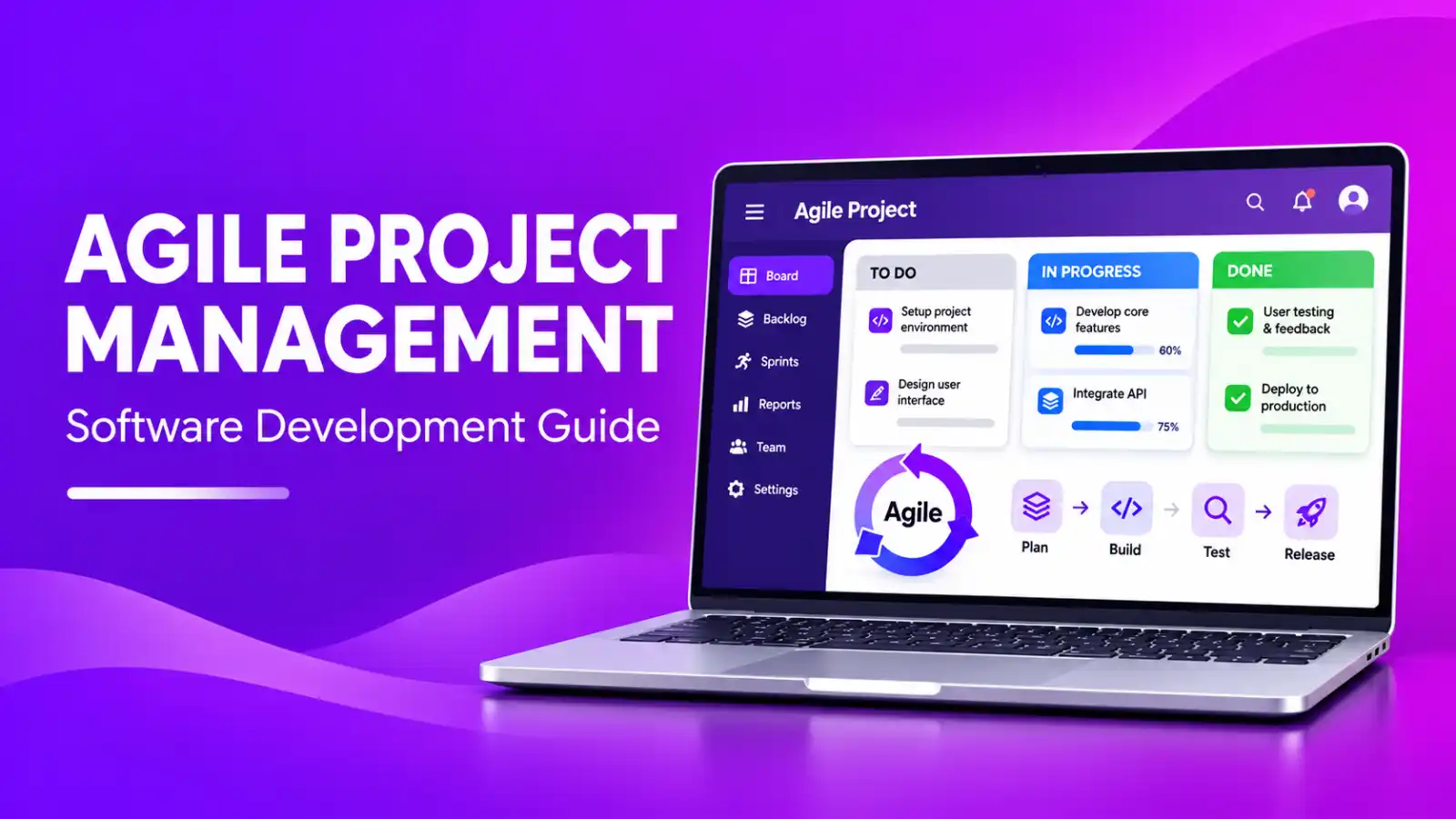
What Is Agile Project Management for Software Development? A Complete Step-by-Step Guide
جدول المحتويات
- 01What Is Agile Project Management?
- 02Why Is Agile Important for Software Development?
- 03How Agile Project Management Works: Step-by-Step
- 04Popular Agile Frameworks
- 05Agile vs. Waterfall Project Management
- 06Major Benefits of Agile Project Management
- 07Common Agile Challenges
- 08Essential Agile Project Management Tools
- 09Practical Example of Agile Software Development
- 10How to Measure Agile Project Success
- 11Frequently Asked Questions
- 12Conclusion
Software development is a rapidly evolving industry where customer expectations, business requirements, and technology constantly change. Traditional project management methods can struggle to accommodate these changes without affecting project schedules and budgets. Agile Project Management provides a flexible, collaborative, and iterative approach to building high-quality software.
Instead of developing an entire software application before collecting customer feedback, Agile enables development teams to work in smaller cycles, regularly test functionality, and continuously improve the product.
Whether a company is developing a website, mobile application, ERP platform, CRM system, or enterprise software solution, Agile can help teams deliver valuable features while responding to changing requirements.
This comprehensive guide explains what Agile Project Management is, how it works, its major frameworks, benefits, challenges, and how to implement Agile successfully in software development.
What Is Agile Project Management?
Agile Project Management is an iterative and incremental approach to planning, developing, testing, and delivering software products.
Rather than completing an entire project through a single fixed sequence, Agile divides development into smaller, manageable activities. Teams regularly assess progress, gather feedback, and adjust priorities based on business needs.
Agile emphasizes teamwork, customer involvement, continuous improvement, and the delivery of working software.
The Agile Manifesto, introduced in 2001, established four fundamental values:
Individuals and interactions over processes and tools.
Working software over comprehensive documentation.
Customer collaboration over contract negotiation.
Responding to change over following a plan.
These values do not eliminate documentation, planning, or established processes. Instead, they prioritize practical collaboration, customer value, and flexibility.
Why Is Agile Important for Software Development?
Software development projects frequently experience changing requirements, unexpected technical challenges, and evolving customer expectations.
Traditional approaches may require extensive planning before development begins. Agile provides a more adaptable alternative.
With Agile, developers can deliver functional features earlier, identify problems sooner, and improve software based on real customer feedback.
For example, an organization developing a School Management System can initially release student registration and attendance features. In subsequent development cycles, the team can introduce examination management, fee collection, reporting, and administrative automation.
This approach allows stakeholders to evaluate working software throughout development rather than waiting for the entire system to be completed.
How Agile Project Management Works: Step-by-Step
Step 1: Identify Project Goals and Requirements
Every successful Agile project begins with a clearly defined business objective.
The development team collaborates with clients, business stakeholders, and product owners to understand the target audience, essential software functions, expected outcomes, and project limitations.
For example, a company developing an e-commerce platform may identify requirements such as product management, customer registration, shopping carts, payment integration, and order tracking.
The goal is to establish a shared product vision without assuming every future requirement is already known.
Step 2: Create a Product Backlog
A Product Backlog is an ordered list of work needed to improve or develop the software.
It may include new features, bug fixes, technical improvements, security enhancements, and user experience updates.
Requirements are often expressed as user stories.
For example:
"As a customer, I want to track my order so that I can understand its delivery status."
The Product Owner prioritizes backlog items according to business value, urgency, risk, and customer expectations.
The backlog is regularly refined as the development team learns more about the product.
Step 3: Select an Agile Framework
Organizations should choose an Agile approach that matches their software development workflow.
Scrum is suitable for teams that benefit from structured development cycles and regular planning.
Kanban is useful for managing continuous work, monitoring workflow, and limiting tasks in progress.
Hybrid approaches can combine structured planning with flexible workflow management.
Choosing the right framework depends on project complexity, team size, stakeholder availability, and the type of development work.
Step 4: Plan the Development Iteration
In Scrum, work is organized into fixed-length periods called Sprints.
A Sprint lasts one month or less, with many software teams choosing one- or two-week cycles.
During Sprint Planning, the Scrum Team establishes a Sprint Goal, selects appropriate work, and develops a practical plan for delivering it.
For example, a two-week Sprint might focus on implementing user authentication and profile management.
The team considers available capacity, technical dependencies, and previously observed performance before selecting work.
Step 5: Develop Software Collaboratively
Once planning is complete, developers begin implementing the selected features.
Typical activities include interface design, backend programming, database development, API integration, code review, and automated testing.
Development teams collaborate closely to address technical problems and maintain code quality.
Version control systems such as Git help teams manage code changes, while automated build and testing processes can reduce integration problems.
Agile encourages collaboration rather than isolated development activities.
Step 6: Monitor Daily Progress
Regular communication helps development teams remain aligned.
In Scrum, the Daily Scrum is a 15-minute event for Developers to inspect progress toward the Sprint Goal and adapt their plan.
Teams may discuss completed work, upcoming activities, and obstacles affecting delivery.
Project management tools such as Jira, Trello, or Azure DevOps can help visualize tasks and identify workflow bottlenecks.
However, Agile should focus on meaningful progress rather than unnecessary reporting or excessive meetings.
Step 7: Test and Review Completed Features
Testing is an essential part of Agile software development.
Teams should evaluate functionality throughout development rather than postponing all testing until the final project stage.
Testing may include unit testing, integration testing, performance testing, security testing, and user acceptance testing.
At the end of a Scrum Sprint, the Sprint Review provides an opportunity for the Scrum Team and stakeholders to inspect the results and discuss future adaptations.
Customer feedback can reveal missing functionality, usability concerns, or opportunities for improvement.
Step 8: Release Working Software
Agile encourages frequent delivery of valuable software.
A completed feature should meet the team's quality expectations and applicable acceptance criteria before being considered ready.
Depending on business needs, software may be released after a Sprint, during a Sprint, or according to a separate deployment schedule.
Continuous Integration and Continuous Delivery practices can support faster and more reliable releases.
For example, an organization may initially launch a basic inventory management module and later introduce supplier management, automated purchase orders, and analytics dashboards.
Step 9: Conduct a Retrospective
Continuous improvement is one of the most important characteristics of Agile.
In Scrum, the Sprint Retrospective allows the team to examine its processes, collaboration, tools, and quality practices.
The team identifies practical improvements that can be introduced into future Sprints.
For example, developers may decide to improve automated testing, clarify acceptance criteria, reduce work in progress, or strengthen communication with stakeholders.
Over time, these improvements can increase productivity and software quality.
Step 10: Repeat and Improve
Agile development continues through repeated planning, implementation, inspection, and adaptation.
The team reviews customer feedback, measures product performance, updates the backlog, and selects the next valuable development activities.
This process allows software products to evolve as business requirements change.
Popular Agile Frameworks
Scrum
Scrum is a lightweight framework for addressing complex problems through iterative delivery.
It defines three accountabilities: Product Owner, Scrum Master, and Developers.
Scrum includes the Sprint, Sprint Planning, Daily Scrum, Sprint Review, and Sprint Retrospective.
It is particularly useful when teams need regular planning, clear product goals, and frequent stakeholder feedback.
Kanban
Kanban focuses on visualizing workflow, managing work in progress, and improving the movement of tasks through a system.
A typical Kanban board contains columns such as To Do, In Progress, Testing, and Done.
Teams may establish Work in Progress limits to prevent overload and identify bottlenecks.
Kanban is often suitable for software maintenance, support activities, and continuously changing work priorities.
Extreme Programming (XP)
Extreme Programming emphasizes technical excellence and disciplined software engineering practices.
Common XP practices include pair programming, test-driven development, continuous integration, refactoring, and frequent customer feedback.
It can be especially useful when software quality and changing requirements are major concerns.
Agile vs. Waterfall Project Management
Aspect | Agile | Waterfall |
|---|---|---|
Approach | Iterative and incremental | Sequential phases |
Planning | Adaptive planning | Detailed upfront planning |
Requirements | Can evolve | Typically established early |
Customer Feedback | Frequent | Often milestone-based |
Testing | Integrated throughout development | Frequently concentrated in dedicated phases |
Delivery | Incremental delivery | Often one major release |
Flexibility | Designed to accommodate change | Changes can require formal replanning |
Neither approach is universally superior. The best choice depends on project requirements, contractual obligations, regulatory constraints, technical dependencies, and business priorities.
Major Benefits of Agile Project Management
Faster delivery of value: Teams can provide useful features earlier without waiting for the complete application.
Improved customer satisfaction: Regular feedback helps align software development with actual customer expectations.
Greater flexibility: Teams can adjust priorities when business or technical circumstances change.
Better visibility: Shared backlogs, development boards, and regular reviews improve project transparency.
Continuous quality improvement: Frequent testing, code reviews, and retrospectives help teams identify problems earlier.
Reduced delivery uncertainty: Small development increments provide opportunities to validate assumptions before making larger investments.
Common Agile Challenges
Although Agile offers significant advantages, successful implementation requires discipline.
Unclear priorities can create confusion and frequent task switching. Poorly defined requirements may lead to unnecessary rework.
Insufficient customer involvement can reduce the value of feedback cycles. Technical debt can increase when teams prioritize speed without maintaining engineering standards.
Agile can also become ineffective when organizations introduce too many meetings or interpret flexibility as an absence of planning.
Successful Agile teams need clear goals, realistic commitments, appropriate documentation, technical discipline, and regular communication.
Essential Agile Project Management Tools
Various software tools can support Agile development.
Jira helps teams manage product backlogs, development workflows, Sprint planning, and reports.
Trello offers visual boards for organizing and tracking work.
Azure DevOps supports work tracking, repositories, testing, and development pipelines.
GitHub combines source code collaboration with issues, project boards, and automation capabilities.
The ideal platform depends on team size, technical requirements, integration needs, and available resources.
Practical Example of Agile Software Development
Consider a business developing a Human Resource Management System.
During the first development cycle, the team creates employee registration and authentication features.
The second cycle introduces employee attendance management.
The third cycle focuses on leave requests and approval workflows.
Later cycles add payroll processing, reporting, notifications, and administrative dashboards.
After each cycle, stakeholders review the completed functionality and identify improvements.
The final product evolves through validated development increments instead of relying entirely on assumptions made at the beginning.
How to Measure Agile Project Success
Project success should not be evaluated only by the number of completed tasks.
Useful indicators include customer satisfaction, successful feature adoption, defect rates, lead time, cycle time, release reliability, and progress toward product goals.
Scrum teams may also use Sprint Goal achievement and historical velocity for internal planning.
Metrics should support better decisions and continuous improvement rather than creating unhealthy competition between teams.
Frequently Asked Questions
1. What is Agile Project Management in simple words?
Agile Project Management is a flexible approach that develops software in smaller stages, using regular feedback to guide improvements.
2. Is Agile only used for software development?
No. Agile approaches are also used in product management, marketing, operations, and other collaborative projects.
3. What is a Sprint in Agile?
A Sprint is a fixed-length development cycle used in Scrum to create a valuable, usable product increment.
4. What is the main difference between Scrum and Agile?
Agile is a broader set of values and principles, while Scrum is a specific framework that applies an iterative, empirical approach.
5. Does Agile guarantee faster development?
No. Agile supports earlier delivery and adaptation, but speed depends on team capability, product complexity, and effective execution.
Conclusion
Agile Project Management has become an important approach to modern software development because it supports flexibility, collaboration, continuous testing, and customer-focused delivery.
By dividing complex projects into manageable development cycles, organizations can identify problems earlier, respond to changing requirements, and continuously improve software products.
Whether developing a business website, mobile application, enterprise ERP system, or cloud-based SaaS platform, Agile offers a practical foundation for delivering reliable and valuable software.
Successful Agile implementation is not simply about using Scrum boards or holding daily meetings. It requires a commitment to technical excellence, meaningful collaboration, measurable outcomes, and continuous learning.
অনুশীলন পরীক্ষা
তাকামুল: ওয়াটার ট্যাংক ক্লিনার
২৫টি প্রশ্ন · ৩০ মিনিট
প্রতিবার নতুন এলোমেলো প্রশ্ন। ফলাফল শুধু আপনিই দেখবেন।
- #Agile Project Management
كتبه
Robin
Editor